…or read full answers:
ADE: What drew you to the story?
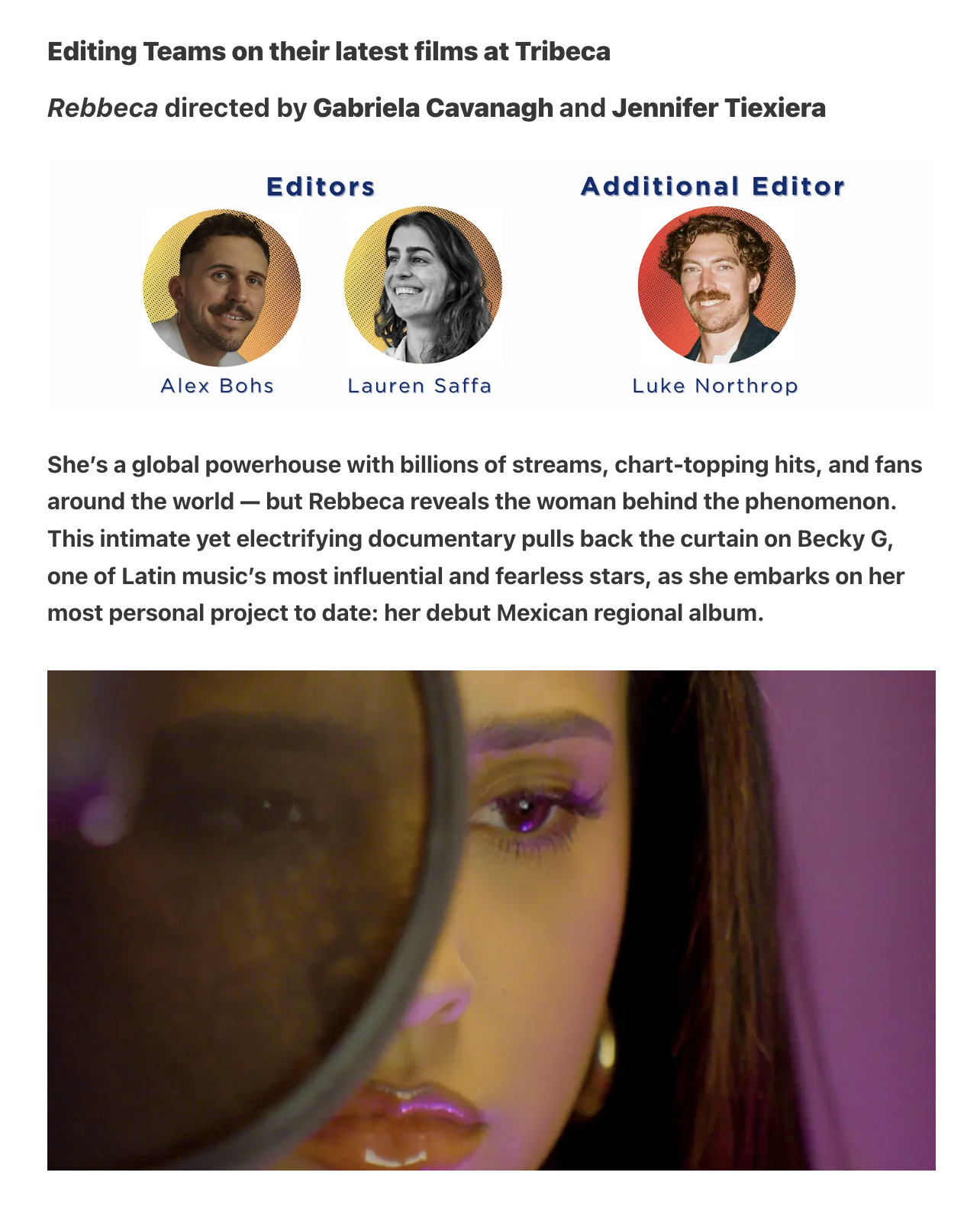
Alex Bohs (editor): One of my earliest editing jobs in LA featured a teenaged Becky, so this project already carried a sense of return. But what truly hooked me was the intimacy of the footage: Gabriela Cavanagh’s atmospheric tour verité, tender home videos—shot on gloriously crackly VHS by Becky’s mom, Alejandra – and Becky’s stunning, personal album Esquinas. I’ve always been drawn to stories that collapse time, where past and present blur – and that quality felt woven into this material from the start. The final draw was getting to reunite and create with Jen Tiexiera as well as edit alongside Lauren Saffa, someone I’d long admired and was excited to finally collaborate with. In every way, it was an easy yes.
Lauren Saffa (editor): I’ve worked with director Jen Tiexiera before, and honestly, I’ll say yes to just about anything she calls me for—she’s an incredible collaborator. When she mentioned a new project about Becky G, I didn’t hesitate. I’m genuinely a fan of Becky’s music, so my first thought was, "Perfect—someone I’d actually enjoy hearing on loop in the edit!" Then I met co-director Gabriela Cavanagh, who had captured such intimate, powerful footage. I was immediately drawn in by the depth of Becky’s story—her roots, her resilience, and her role as a voice for a generation navigating bicultural identity and representation.
What was your approach to editing the film?
Alex: We set out to make something deeply intimate. Becky’s world is already so vibrant – larger than life. The edit was less about building energy and more about channeling it. With two directors who are also editors, collaboration was baked into the process. We shared a shorthand and an openness to exchanging rough cuts without hesitation. Working under a fast timeline, that kind of fluid back-and-forth gave room for nuance and beauty to emerge. Lauren and I were trading full sections of the film remotely (via Avid), and in a way, it felt like film school all over again. I’d hand off a scene and get it back with a new rhythm or layer I hadn’t expected. That kind of exchange made me less precious—and more proud—of the final result. Want to shout out Luke Northrop (additional editing) as well, who elevated the film’s electric concert sequences, allowing Lauren and me space to shape the emotional arcs alongside Jen and Gaby. Everyone had a focus, and we were in constant motion – our own little tour, each stop handled with care, intention, and more than a few bloodshot eyes (at least on my end).
Lauren: Our approach was really collaborative from the beginning—lots of creative conversations with our amazing directors, Jen and Gaby. They had a strong vision but were also super open to experimentation, which made the process feel exciting and dynamic. From early on, they wanted to lean more on voice over and less on sit down interviews, and they were also interested in exploring more abstract, dreamlike sequences—which gave us the chance to really play with tone and rhythm in the edit. The timeline was fast, so we had to keep pushing forward, even when certain transitions or story threads weren’t fully locked in. It was a balancing act between staying creative and staying on schedule. Working with Alex was also a huge plus—we traded sections often, which helped keep the edit fresh and gave us space to constantly bring new energy and perspective to each pass.
How has being a member of ADE supported your career?
Alex: I’ve been working in documentary editing since around 2013, but I’m new to the ADE world. Over the past few years, I’ve tried to be more intentional about building community: grabbing coffee with editors I admire and reconnecting with past collaborators. Joining ADE felt like a natural next step. It’s been great meeting other puzzle-solvers who truly understand how isolating this work can be. That kind of shared space makes a real difference, and I’m looking forward to more conversations, connections, and events ahead.
Lauren: Having a community of editors is huge. This can be a pretty solitary job at times, so it’s a lifesaver to have folks you can reach out to, whether you need creative input, help untangling a story knot, or just someone who understands the specific pain of staring at the same 12 seconds of footage for five hours. Honestly, I don’t leave my house or connect with other editors as often as I should, but every time I do, I’m reminded how important that support system is. It’s nice to be reminded you’re not losing your mind—at least not alone.
What's the biggest issue facing the field of documentary editing?
Alex: T-I-M-E. It keeps shrinking. Each feature I’ve edited in the past five years has offered less of it, and the impact is clear–not only in the final product, but in our ability to keep doing this work sustainably. It’s something I hear echoed constantly among fellow editors. We’re all feeling the pressure, trying to craft thoughtful, nuanced stories on tighter timelines than ever. The documentary space in particular needs to take a hard look at how we structure edits and allocate resources. As the industry shifts, we can’t afford to normalize burnout. We need to keep pushing for change.
Lauren: One of the biggest challenges right now is the lack of time and resources to make documentaries with the depth and care they deserve. Truly honoring participants’ stories ideally means spending months, even years, embedded in their lives. But the current pace of production often makes that impossible. On the post-production side, where I once had a year to shape a feature, I’m now expected to finish in just three or four months. The constant push for content—especially from streaming platforms—has created a volume-over-depth environment that’s exhausting for creators and overwhelming for audiences. But despite all that, I really believe in our art form! Documentary is still one of the most powerful and intimate ways to tell human stories, and that keeps me inspired.